Keywords: Term sheet, startup investment, venture capital, startup funding, investment agreements, startup law Nigeria, corporate finance law, venture capital Nigeria
In conversations around startups and fundraising, much attention is often given to the amount of money being raised, the valuation attached to the company, or the profile of the investors involved. Headlines frequently celebrate “successful funding rounds,” while founders proudly announce that they have secured investment to scale their businesses.
Behind many of these announcements lies a document that is often misunderstood, underestimated, or rushed through by inexperienced founders; the term sheet.
For many early-stage businesses, the excitement of attracting investors can overshadow the importance of understanding the legal and commercial implications of the deal being proposed. In reality, some of the most significant decisions affecting the future of a startup are made long before the definitive agreements are signed. Those decisions often begin with the term sheet.
Understanding how term sheets work is therefore not merely a legal exercise. It is an essential part of understanding investment itself.
What Exactly is a Term Sheet?
A term sheet is a preliminary document that outlines the principal terms and conditions upon which an investment is proposed.
In simpler terms, it serves as the framework for the proposed deal between investors and the company. It captures the key commercial and governance arrangements that the parties intend to formalise in subsequent binding agreements.
Although term sheets are generally regarded as preliminary documents, they are often highly influential because they shape the direction of negotiations and establish expectations between the parties.
A founder who misunderstands the implications of a term sheet may unknowingly concede significant control, ownership, or strategic flexibility long before the final agreements are prepared.
Why Term Sheets Matter More Than Many Founders Realise
One of the most common misconceptions among startup founders is the belief that the term sheet is merely a formality before the “real” legal documentation begins, this assumption can be costly.
In practice, the term sheet often contains the most commercially important elements of the transaction, including:
- The valuation of the company
- The percentage of equity to be transferred
- Governance rights
- Investor protections
- Control mechanisms
- Future fundraising implications
By the time definitive agreements are drafted, many of these issues have already been substantially negotiated and settled.
The term sheet therefore operates as the foundation upon which the investment structure is built.
Consider a hypothetical technology startup founded by two young entrepreneurs seeking capital to expand operations.
After several months of pitching, an investor offers to invest ₦80 million into the company. The founders, excited by the opportunity, focus primarily on the amount being offered and the public perception of successfully “raising funds.”
The term sheet proposes:
- A significant equity stake for the investor
- Bard representation rights
- Veto powers over certain company decisions
- Restrictive provisions regarding future fundraising
Believing that these terms are standard and eager to secure the investment quickly, the founders proceed without obtaining proper legal guidance.
Two years later, the company grows significantly. However, the founders discover that:
- They no longer maintain effective control over major company decisions
- Future investors are hesitant due to restrictive rights granted earlier
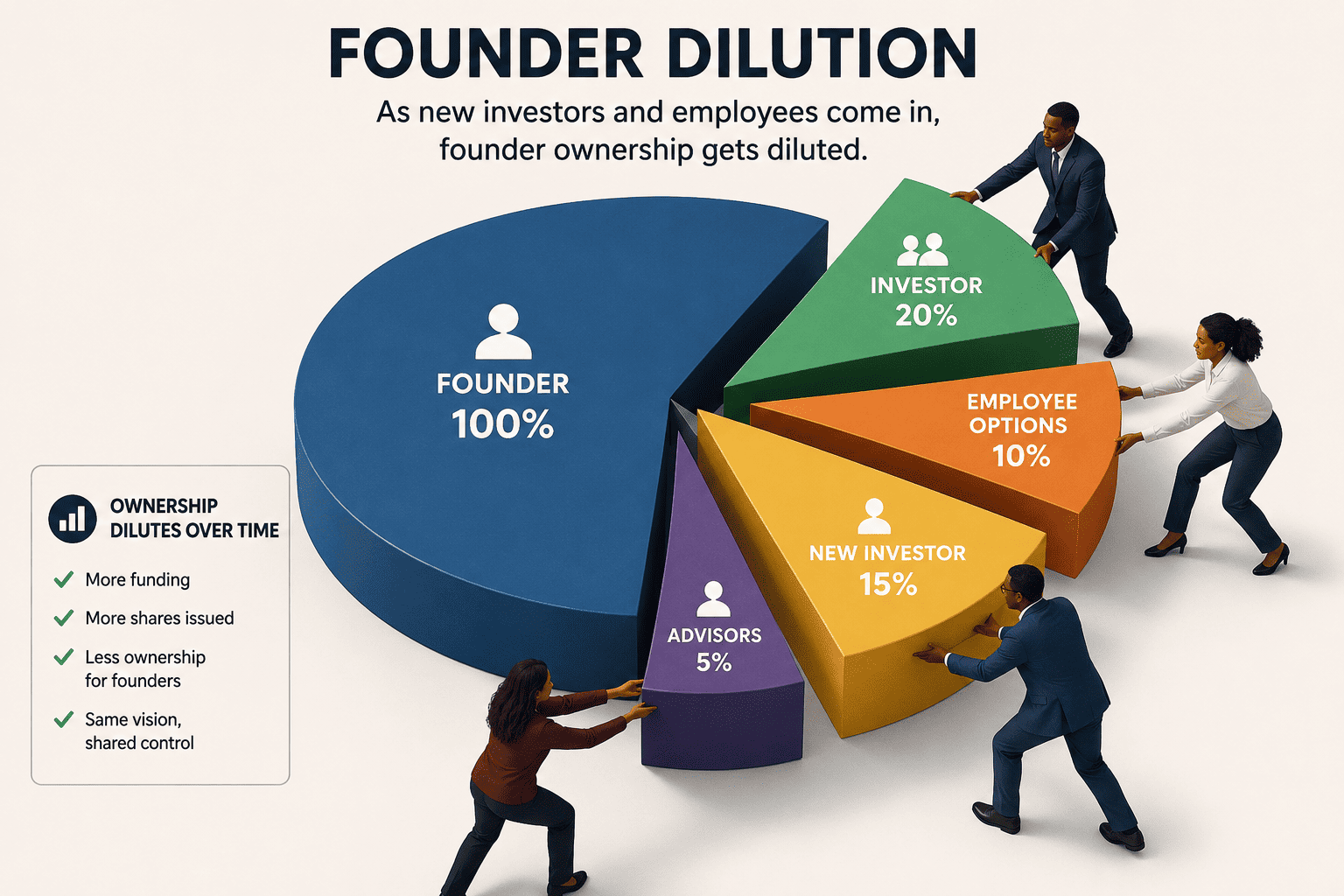
- Dilution has significantly reduced their ownership position
The issue was never merely the investment amount; it was the structure of the deal.
This scenario reflects a recurring reality within startup ecosystems globally: founders frequently underestimate the long-term implications of early investment terms.
Key Clauses Every Founder Should Understand
While term sheets vary depending on the nature of the transaction, certain provisions consistently appear in venture capital and startup investments.
Understanding these clauses is essential.
1. Valuation
Valuation determines how much the company is considered to be worth at the time of investment.
This directly affects:
- How much equity the investor receives
- The level of dilution experienced by existing shareholders
Founders often focus on obtaining high valuations for prestige purposes, but valuation must also be considered in relation to:
- Growth expectations
- Future funding rounds
- Investor rights attached to the investment
An inflated valuation may appear attractive initially but can create significant pressure during subsequent fundraising rounds.
2. Equity Allocation
The term sheet will specify the percentage ownership the investor receives in exchange for their capital.
This is one of the most significant aspects of the transaction because ownership directly affects:
- Voting rights
- Control
- Economic participation
- Future dilution
Many founders underestimate how quickly ownership can diminish across multiple funding rounds.
3. Board Representation and Control Rights
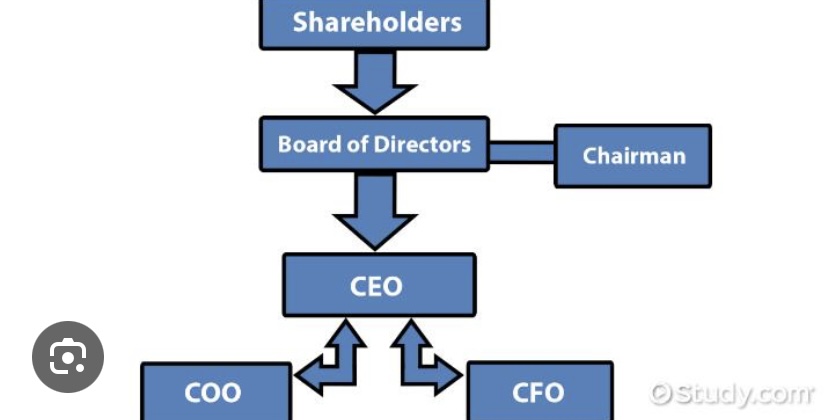
Investors often request the right to appoint directors or observers to the company’s board.
While this may appear reasonable, founders must understand that governance rights can significantly influence:
- Operational decision-making
- Strategic direction
- Future fundraising decisions
Some term sheets also contain “reserved matters” provisions, requiring investor consent before certain actions can be taken.
These may include:
- Issuing additional shares
- Taking on debt
- Changing business direction
- Appointing senior management
4. Liquidation Preference
Liquidation preference determines how proceeds are distributed if the company is sold or liquidated.
This clause is particularly important because it can affect whether founders benefit financially from an exit event.
For example, an investor with a strong liquidation preference may recover their investment first before founders or ordinary shareholders receive anything. Many founders overlook this provision entirely during negotiations.
5. Anti-Dilution Protection
Anti-dilution clauses protect investors if future funding rounds occur at lower valuations.
While such provisions are common in venture capital transactions, they can significantly impact founder ownership if not carefully negotiated.
6. Vesting Provisions
Founders are sometimes required to vest their shares over time.
This means ownership may be tied to continued involvement in the company.
While vesting can align long-term commitment, founders should fully understand:
- Vesting timelines
- Acceleration provisions
- Consequences of departure
- Are Term Sheets Legally Binding?
A common question is whether a term sheet is legally enforceable.
The answer is nuanced.
In many cases, the commercial provisions of a term sheet are described as “non-binding,” meaning the parties still intend to negotiate and execute definitive agreements.
However, certain clauses are often expressly binding, including:
- Confidentiality obligations
- Exclusivity provisions
- Dispute resolution clauses
- Governing law provisions
More importantly, even non-binding terms can carry substantial practical influence because they shape subsequent negotiations. Once parties have aligned on core economic and governance terms, reversing those positions later may be commercially difficult.
The Nigerian Startup Landscape and the Growing Importance of Investment Literacy
Nigeria’s startup ecosystem continues to attract increasing local and international investment interest. As more founders seek venture capital and institutional funding, the sophistication of investment structures is also increasing.
This evolution makes legal and commercial literacy more important than ever.
Many founders build impressive products but lack sufficient understanding of:
- Deal structuring
- Governance implications
- Ownership management
- Investor protections
Fundraising is not simply about obtaining capital, it is about entering into long-term legal and commercial relationships. A poorly negotiated investment structure can create challenges that persist long after the funding itself has been spent.
Common Founder Mistakes During Investment Negotiations
Certain patterns frequently emerge in early-stage fundraising discussions.
These include:
- Focusing exclusively on valuation and funding amount
- Ignoring governance and control implications
- Failing to obtain legal review
- Accepting aggressive investor protections without negotiation
- Misunderstanding dilution effects
In many cases, these mistakes arise not from carelessness, but from inexperience and urgency. Founders eager to secure investment often prioritise immediate survival over long-term structural consequences.
In conclusion, term sheets occupy a unique position in startup financing. Although preliminary in form, they frequently determine the commercial architecture of the investment relationship. For founders, understanding a term sheet is not about becoming lawyers, it is about becoming more informed participants in the businesses they are building.
The strongest founders are not merely product builders or fundraisers. Increasingly, they are individuals who understand how ownership, governance, and investment structures shape the future of their companies.
In modern startup ecosystems, capital alone is rarely the defining factor between successful and unsuccessful businesses.
Structure matters, governance matters, documentation matters, and often, those realities begin with a single document: the term sheet.