Keywords: Founder dilution, startup ownership, venture capital, startup finance, ESOP, employee stock option pool, startup governance, investment structuring, startup law Nigeria, venture capital Nigeria
For many entrepreneurs, starting a company represents far more than the creation of a business. It represents ownership, vision, independence, and the ability to shape the future of an idea from inception to scale. In the earliest stages of a startup, founders often exercise complete control over the businesses they build. Decisions are made internally, ownership remains concentrated, and the direction of the company is largely determined by the founders themselves.
However, as businesses grow and external capital becomes necessary, ownership structures begin to evolve. New investors come in, additional shares are issued, governance structures become more sophisticated, employees receive equity incentives, and boards become formalised. Over time, many founders discover a difficult but important reality:
Building a company does not necessarily mean permanently controlling it, and this is where the concept of founder dilution becomes significantly important.
In modern startup ecosystems, some of the world’s most successful companies have experienced significant shifts in ownership and control as they scaled. Founders who once held complete authority gradually found themselves negotiating governance rights, investor protections, and ownership percentages that looked very different from where they began.
Understanding dilution is therefore not simply a financial exercise. It is central to understanding how modern startups grow, how investment structures function, and how control within companies evolves over time.
What is Founder Dilution?
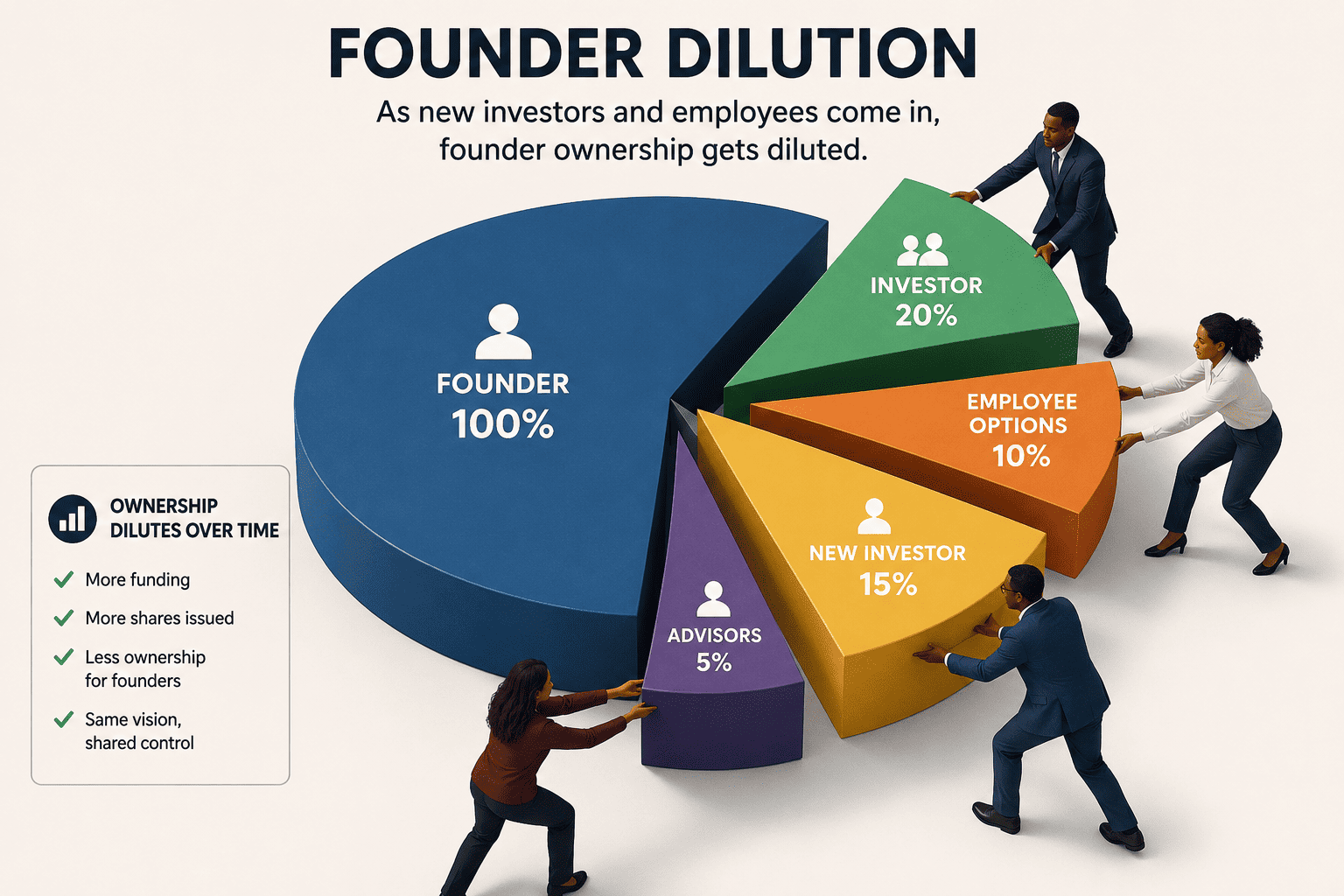
Founder dilution occurs when a company issues additional shares, causing the percentage ownership of existing shareholders to reduce. Importantly, dilution does not necessarily mean a founder loses shares in absolute terms. Rather, the founder owns a smaller percentage of a now larger company. This distinction is essential.
A founder may still hold the same number of shares while possessing significantly less ownership influence because the total number of shares in the company has increased.
In practical terms, dilution occurs whenever:
- Investors receive equity in exchange for capital
- Employee stock options are created
- Additional shares are issued during fundraising rounds
- Convertible instruments are converted into equity
As startups scale and raise capital over time, dilution becomes a recurring part of the company’s evolution.
Consider a startup founded by a single entrepreneur who initially owns 100 shares out of 100 total shares in the company.
At this stage the founder owns 100% of the business
The company later raises external investment, and to accommodate the investor, the company issues 50 new shares.
The ownership structure now becomes:
- Founder: 100 shares
- Investor: 50 shares
- Total shares: 150
Although the founder still owns the same 100 shares, the founder’s percentage ownership has reduced from 100% to approximately 66.7%.
This is dilution.
As additional investment rounds occur, ownership percentages may continue to decrease further.
The Reality of Multiple Funding Rounds
Dilution becomes more significant as startups progress through different stages of financing.
A hypothetical company may experience the following ownership progression:
Initial Stage
Founder Ownership: 100%
Seed Investment
Founder Ownership: 75%
Series A Funding
Founder Ownership: 52%
Series B Funding
Founder Ownership: 31%
Later Funding Stages
Founder Ownership: Below 20%
At first glance, such reductions may appear alarming. However, dilution itself is not always negative.
If the company’s valuation increases substantially, a smaller percentage of a significantly larger company may still be highly valuable.
A founder who owns 20% of a billion-dollar company may ultimately possess far greater value than a founder who owns 100% of a struggling small business.
The issue therefore is not dilution alone. The real issue is whether dilution occurs strategically, sustainably, and with a proper understanding of its long-term implications.
Ownership Does Not Always Mean Control
One of the most misunderstood realities of startup financing is the distinction between ownership and control.
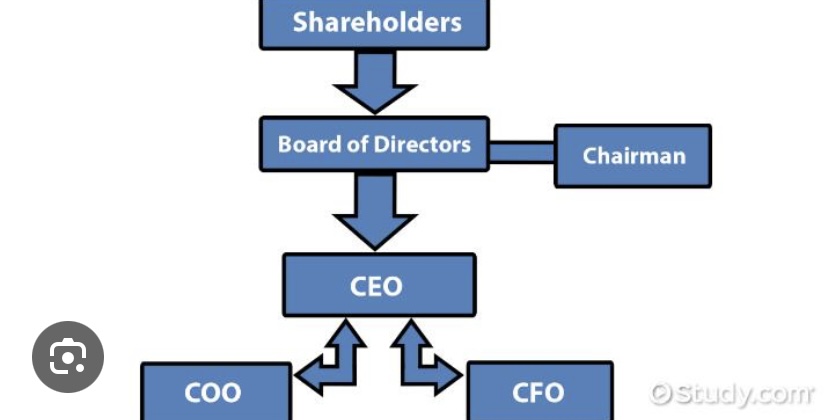
A founder may continue serving as Chief Executive Officer while gradually losing the ability to independently influence major decisions within the company.
This can happen through:
- Investor board representation
- Voting rights
- Shareholder agreements
- Reserved matters provisions
- Protective investor clauses
In some situations, investors gain substantial influence over:
- Fundraising decisions
- Executive appointments
- Acquisitions
- Governance matters
- Strategic direction
As companies mature and institutional investors become involved, governance structures typically become more sophisticated and formalised.
This means that even where founders remain publicly associated with the company, actual decision-making authority may increasingly depend on broader shareholder and board dynamics.
Why Dilution Happens
Despite concerns surrounding founder dilution, it is important to recognise that dilution is often a natural consequence of growth.
Scaling a business requires:
- Capital
- Infrastructure
- Operational expansion
- Talent acquisition
- Market penetration
External funding allows startups to:
- Hire employees
- Expand operations
- Improve products
- Enter new markets
- Compete more effectively
In many cases, dilution is therefore not a sign of failure, but part of the process of transforming a small startup into a scalable enterprise.
The significant issue is whether founders understand the long-term ownership and governance implications of the structures they are creating.
The Role of Employee Stock Option Pools (ESOPs)
Another important but frequently misunderstood contributor to dilution is the creation of an Employee Stock Option Pool (ESOP).
An ESOP is a portion of company shares reserved for employees, advisors, consultants, or future team members as part of compensation and incentive structures.
In startup ecosystems, particularly within technology companies, ESOPs are widely used to attract and retain talented individuals when immediate cash compensation may be limited.
Rather than relying entirely on salaries, startups often offer selected employees the opportunity to acquire ownership interests in the company over time. This creates alignment between employee performance and the long-term success of the business.
However, ESOPs also contribute to dilution.
For example, where a company creates a 10% or 15% option pool for future hires, the ownership percentages of existing shareholders, including founders may reduce accordingly.
This becomes particularly important during fundraising negotiations because investors frequently require startups to establish or expand ESOP pools before investments are completed.
In practice, this means founders may experience dilution not only from investor participation, but also from equity reserved for future talent acquisition.
Nevertheless, when properly structured, ESOPs can significantly strengthen a company by helping it attract skilled personnel who contribute meaningfully to growth and scalability.
The important issue is therefore not merely whether an ESOP exists, but:
- How large the option pool is
- How it is structured
- How it affects long-term ownership dynamics within the company.
When Dilution Becomes Dangerous
Problems often arise when founders give away equity too aggressively during the early stages of the company.
This may occur because:
- Founders are desperate for funding
- Investors possess stronger negotiating leverage
- Founders lack adequate legal or financial advisory support
- Short-term survival is prioritised over long-term positioning
Inexperienced founders sometimes underestimate how future fundraising rounds compound dilution effects over time.
A founder who transfers significant equity early may later discover that:
- Negotiating power has weakened
- Ownership has reduced substantially
- Investor influence has increased significantly
- Future fundraising becomes more complicated
In extreme situations, founders may even lose executive control over the companies they created.
The consequences of poorly structured early fundraising decisions often become more visible only years later.
Global Startup Lessons
The issue of founder control is not merely theoretical. The global startup ecosystem contains numerous examples of founders whose influence within their companies changed significantly after external investment and governance restructuring.
The business world has witnessed situations where founders:
- Lost voting influence
- Were removed from leadership positions
- Became constrained by investor governance mechanisms
These examples demonstrate a broader truth about venture-backed companies:
Capital frequently comes with governance consequences, and as institutional funding increases, the balance between founder autonomy and investor protection becomes increasingly delicate.
The Nigerian Startup Context
Nigeria’s startup ecosystem has experienced substantial growth in recent years, attracting increasing local and international investor attention.
However, many founders still possess limited understanding of:
- Dilution mechanic
- Shareholder structuring
- Governance implications
- Long-term ownership management
Fundraising discussions often focus heavily on:
- Valuation
- Investment amounts
- Public perception of funding success
While insufficient attention is paid to:
- Ownership sustainability
- Investor rights
- Governance structures
- Long-term founder positioning
This creates vulnerabilities, particularly for early-stage founders navigating investment transactions for the first time.
As Nigerian startups continue integrating into global investment ecosystems, understanding these concepts becomes increasingly important.
How Founders Can Protect Themselves
Protecting against harmful dilution does not require founders to avoid investment altogether. Rather, it requires approaching fundraising strategically and with proper advisory support.
Important considerations include:
1. Understanding Investment Documents
Founders should fully understand term sheets, shareholder agreements, governance clauses, and investor rights before execution.
2. Avoiding Excessive Early Equity Transfers
Giving away substantial ownership percentages too early may create long-term structural challenges.
3. Thinking Beyond Immediate Funding
Investment should not be evaluated solely based on the amount of capital being offered; the structure of the transaction matters equally.
4. Structuring ESOPs Carefully
Employee equity pools should be thoughtfully designed to balance talent acquisition with sustainable ownership management.
5. Building Strong Governance Structures
Clear governance frameworks help preserve alignment between founders, investors, and other stakeholders.
6. Seeking Professional Advisory Support
Legal and financial guidance can significantly improve negotiation outcomes and long-term positioning.
In conclusion, founder dilution is one of the defining realities of modern startup financing. While external investment can accelerate growth and unlock significant opportunities, it also reshapes ownership structures and governance dynamics within a company.
For founders, the objective is not necessarily to avoid dilution altogether. In many successful businesses, dilution is part of sustainable growth.
The real challenge is ensuring that fundraising occurs strategically, with a proper understanding of how ownership, influence, governance, and long-term control evolve over time.
Many founders begin their entrepreneurial journey believing that building a company guarantees permanent control over it. However, modern startup ecosystems demonstrate otherwise. Raising investment is not simply about receiving capital. It is about navigating the complex relationship between growth, ownership, governance, talent, and long-term strategic control.
Understanding dilution is therefore not merely a financial necessity, it is an essential part of building intelligently and sustainably in today’s investment-driven business environment.