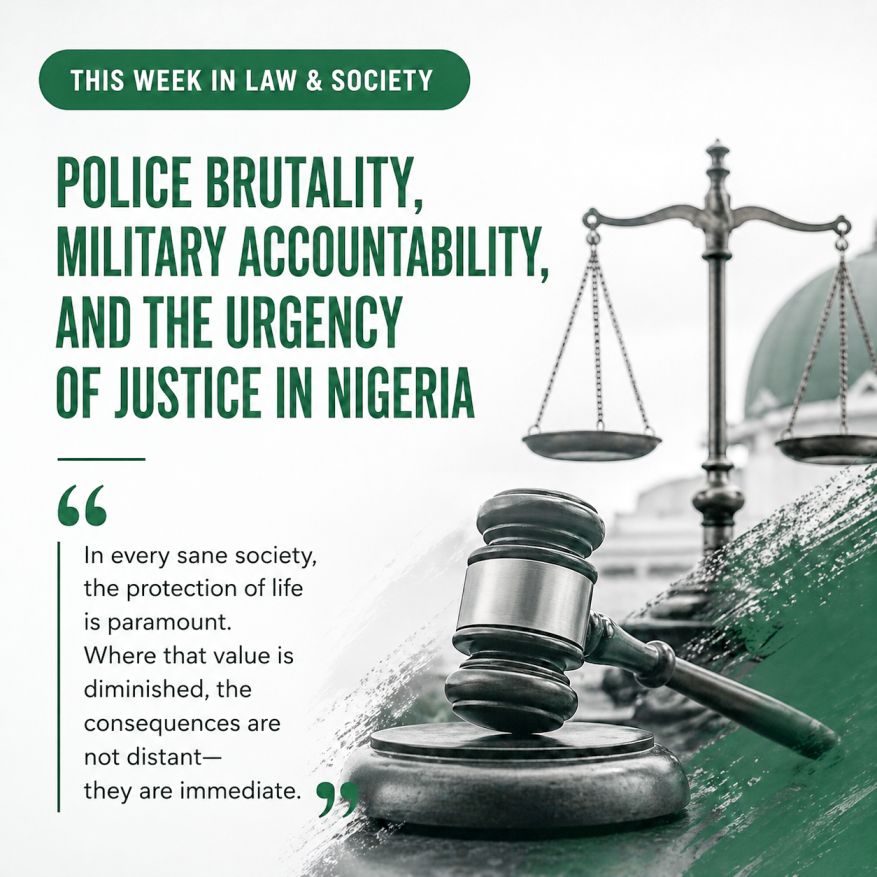
In recent times, Nigerians have become increasingly familiar with a disturbing sight outside some court premises, particularly the Federal High Court in Abuja. Before a matter is called, before lawyers can announce their appearance, and sometimes before members of the public can even find their seats, security operatives have already taken effective control of who gets in and who does not. Lawyers have been stopped at the gates, and journalists have been turned away or made to wait indefinitely. Ordinary citizens have been questioned, delayed, and in some cases refused entry entirely. Recent proceedings involving activist Omoyele Sowore brought this into sharp public focus, with reports of lawyers being barred from court premises, supporters confronted, and allegations of physical intimidation by security personnel.
Most people who hear about these incidents quickly move on. It feels like a political story, or simply a reflection of how things work in Nigeria. But that instinct to look away is precisely the problem, because what is happening outside those courtroom gates is not merely a security matter. It is a constitutional one, and it deserves to be treated as such.
A Court Is a Public Place
The starting point for this conversation is a principle so fundamental it is easy to overlook. Courts are not private institutions. They are not government offices where access can be restricted at the discretion of whoever is stationed at the door. They are public spaces, established specifically to administer justice on behalf of all citizens, and the openness of that process is not incidental; it is essential. The principle of open justice is one of the oldest foundations of democratic legal systems. It exists because the framers of those systems understood something important: justice that cannot be observed cannot be trusted.
Open courts allow citizens to see how the law operates, how judges reason, and how the rights of individuals are weighed against the interests of the State. They hold the process accountable to the public it serves. When that access becomes subject to the discretion of a security operative rather than a lawful direction from the court itself, a serious question arises; one that goes well beyond the inconvenience of a delayed entry. Who is actually in charge of the courthouse? And under whose authority are decisions being made about who may witness justice being done?
Security Has a Role - But That Role Has Limits
To be clear, we are not arguing that courts should be unprotected. Courts handle some of the most sensitive and volatile matters in public life; terrorism cases, election disputes, high-profile corruption trials, proceedings involving powerful political figures. Security agencies have a legitimate and important role in maintaining order, protecting judges, staff, lawyers, and the public, and ensuring that proceedings are not disrupted. That role is real, and it should be respected.
But there is a significant difference between security that enables justice and security that obstructs it. The moment security personnel begin making practical decisions about who may attend open court proceedings the line between protection and interference has been crossed. Security screening at a courthouse entrance is one thing. Selectively determining which lawyers may enter, which journalists may observe, and which members of the public are permitted to witness a hearing is something else entirely. One is a safety function, while the other is a judicial function, and it should never be exercised by anyone other than the court.
How It Works Elsewhere
It is worth looking briefly at how mature democracies handle court security, because the contrast is instructive. In the United Kingdom, the United States, and Canada, security screening at court entrances is standard. Visitors pass through metal detectors, bags are searched, and in high-profile cases additional measures may be in place. None of that is controversial. What those systems maintain, however, is a clear boundary: security agencies manage safety, and the court manages access. Security officers do not decide which members of the public may attend an open hearing. They do not choose which journalists are permitted to report on a case. Those decisions, where they need to be made at all, rest with the judiciary, not with the agencies stationed outside.
That distinction is not bureaucratic. It is the difference between a security function and an interference with the administration of justice. Nigeria’s courts need security, but they also need that boundary to be taken seriously.
The Danger of Gradual Normalisation
Some argue that these incidents are isolated and do not point to a wider problem. While that view may seem reasonable, it deserves closer examination.
Constitutional democracies are rarely undermined by a single dramatic event. More often, they are weakened gradually through a series of small actions that may appear harmless on their own but, over time, have far-reaching consequences.
The real danger is that, little by little, a new normal begins to emerge without any formal announcement. A situation where access to the courts is no longer seen as a right governed by law, but as a privilege dependent on the discretion or goodwill of those stationed at the gate.
That is not a minor change. It is a significant shift with serious implications for the administration of justice. The troubling reality is that such changes often go unnoticed until they have become deeply rooted in the system.
What This Does to Public Confidence
There is a principle in law that justice must not only be done but must be seen to be done. It is often quoted, but its practical implications are worth sitting with. Public confidence in the judiciary does not come only from correct legal decisions, it comes from the perception that the process itself is fair, open, and free from interference. When lawyers feel uncertain about whether they will gain access to a court where their client’s matter is listed, when journalists cannot be sure they will be permitted to report on a proceeding, when citizens begin to regard courts as tightly controlled spaces rather than open public institutions, that confidence erodes. And once it erodes, it is very difficult to rebuild. The legitimacy of the judicial process depends not just on what happens inside the courtroom, but on the public’s ability to see and believe in what is happening.
Where Is the Nigerian Bar Association?
This is a question that is being asked more frequently within legal circles, and it is a legitimate one.
The Nigerian Bar Association (NBA) is more than a professional association concerned with the welfare of lawyers. It is one of the foremost defenders of the rule of law in Nigeria and a key stakeholder in the administration of justice.
When lawyers face unlawful restrictions while carrying out their professional duties, especially when access to court premises becomes subject to the discretion of security personnel rather than established legal procedures, the NBA has a responsibility to speak up and take action.
This is not about politics or the popularity of any particular litigant. It is about protecting the independence of the legal profession and preserving the integrity of the institutions upon which justice depends.
If access to the courts can be restricted without lawful justification today, the consequences may be far-reaching tomorrow. That is why this issue deserves the attention of the NBA, the judiciary, and all who are committed to upholding the rule of law in Nigeria.
The Bigger Picture
It is easy to see this as a problem that affects only lawyers or journalists. But the reality is that the implications go far beyond any profession.
Courts are where businesses go to enforce contracts and resolve disputes. They are where citizens seek protection when their rights are violated. They are where the law acts as a check on power and where justice is expected to be administered fairly and openly.
When public confidence in the independence and accessibility of the courts begins to decline, the effects are felt throughout society. It can affect business confidence, discourage investment, weaken public trust in institutions, and raise concerns about whether decisions are being guided by the rule of law or by the discretion of those who wield power.
This is not just a legal issue, it is a national issue.
Security and justice should work hand in hand. There is nothing wrong with ensuring that court premises are safe and orderly. In fact, a secure court environment helps protect the integrity of the judicial process.
However, security must not go beyond its proper role. Security personnel are there to maintain order and protect lives, not to determine who may access the courts or observe judicial proceedings. The courtroom is not a military base or a restricted government facility. It is the house of justice, and decisions regarding access to it should ultimately rest with the judiciary and the law.
The reports emerging from the Federal High Court in Abuja should concern every lawyer, judge, journalist, and citizen who values the rule of law. Because when access to justice becomes subject to arbitrary control, the consequences are rarely immediate or dramatic. They often develop quietly and gradually, until one day the damage is impossible to ignore.
That is why these developments deserve attention now, before they become accepted as normal.