
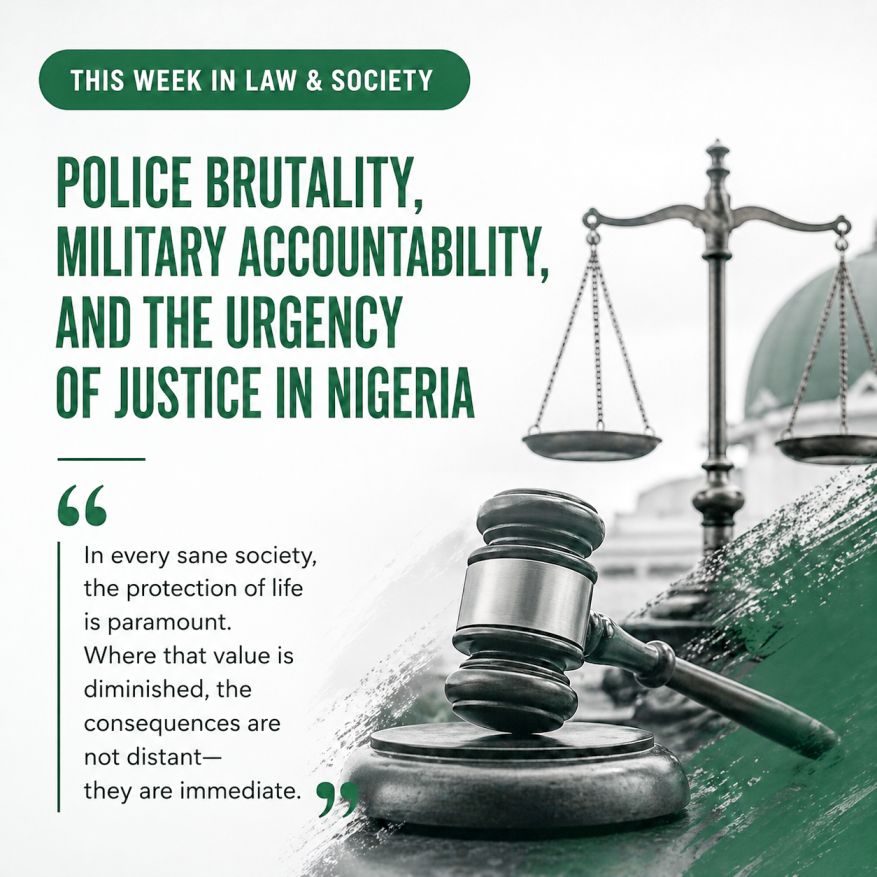
Recent events in Nigeria have once again brought to the forefront a deeply troubling reality; the fragility of human life in the face of unchecked state power. Within the span of days, reports emerged of a young man fatally shot by a police officer in Delta State, and another incident involving the killing of a young corps member allegedly by military personnel under controversial circumstances.
These incidents are not isolated. They form part of a broader and persistent pattern that raises fundamental questions about accountability, institutional responsibility, and the effectiveness of Nigeria’s justice system.
The Warri Incident: A Disturbing Display of Extrajudicial Force
In late April 2026, a viral video showed a police officer in Effurun, Delta State, fatally shooting a restrained young man identified as Mene Ogidi. Reports indicate that the victim had been apprehended in connection with a parcel allegedly containing a firearm.
What has shocked the public most is not merely the death, but the circumstances surrounding it. The victim was reportedly already subdued, hands tied, and even offering cooperation at the time of the shooting.
The Nigeria Police Force has since acknowledged the act as an extrajudicial killing, confirming that the officer acted in violation of established rules governing the use of firearms.
While the officer has been arrested and subjected to internal disciplinary processes, the fundamental question remains:
Is disciplinary action enough?
A Broader Pattern: The Crisis of Excessive Force
The Delta incident is symptomatic of a wider problem, the normalization of excessive force by security personnel.
The principle is simple:
No officer has the legal authority to act as investigator, judge, and executioner.
This position has also been echoed by legal and professional bodies, including the Nigerian Bar Association, which condemned the killing as a violation of the rule of law.
Yet, despite repeated public outrage and institutional statements, similar incidents continue to occur.
The Military Incident: Questions Without Clear Answers
In the same period, reports emerged of a young corps member allegedly shot by military personnel during an operation said to be targeting criminal elements. The military attributed the incident to a “wrongful discharge.”
However, as is often the case, public narratives and family accounts have raised contradictions, highlighting a recurring issue in such incidents: conflicting accounts, limited transparency, and delayed clarity
This raises an important concern; whether internal investigations conducted by security institutions are sufficiently independent, transparent, and credible.
Disciplinary Action vs Criminal Accountability
In many cases, the response of security institutions follows a familiar pattern:
- Arrest or detention of the officer
- Internal disciplinary proceedings
- Public assurances of justice
While these steps are necessary, they are not sufficient.
Extrajudicial killing is not merely a disciplinary offence; it is a criminal act.
The law requires that:
- Proper investigations be conducted
- Evidence be presented
- Offenders be prosecuted in a court of law
Anything short of this risks reducing serious violations of human rights to internal administrative matters.
The Justice System Question: Is It Effective Enough?
Even where cases proceed beyond internal discipline, another challenge arises; the effectiveness of the justice system
Concerns persist regarding:
- Delays in prosecution
- Weak investigative processes
- Lack of follow-through
- Institutional interference or protection
Where justice is delayed or uncertain, public confidence erodes. Over time, this creates a dangerous environment where individuals begin to lose faith in lawful processes.
Institutional Protection and the Risk of Cover-Ups
One of the most troubling aspects of such incidents is the perception, sometimes reinforced by experience, that institutions may shield erring officers.
This may occur through:
- Delayed investigations
- Lack of transparency
- Inconsistent communication
- Internal handling without external scrutiny
Where accountability is compromised, impunity thrives.
Why This Matters: The Risk to Society
In every functioning society, the protection of life is paramount.
When citizens begin to feel unsafe, not from criminals alone, but from those tasked with protecting them the consequences are profound.
Unchecked abuses can lead to:
- Public distrust
- Social unrest
- Normalization of unlawful force
- Eventual breakdown of order
In such an environment, the line between law enforcement and lawlessness becomes dangerously blurred.
Recommendations: A Multi-Stakeholder Responsibility
Addressing these challenges requires coordinated action across multiple levels:
Security Institutions (Police & Military)
- Strengthen enforcement of rules governing use of force
- Implement regular psychological and mental assessments for officers
- Improve recruitment standards and training
- Ensure transparency in investigations
Government
- Establish independent oversight mechanisms
- Enforce accountability beyond internal discipline
- Provide adequate funding and reform for law enforcement
Judiciary / Justice System
- Ensure timely prosecution of cases
- Strengthen judicial independence
- Prioritize human rights violations
Victims and Families
- Document evidence where possible
- Engage legal representation early
- Pursue lawful channels for redress
The Public
- Demand accountability through lawful means
- Support institutional reforms
- Avoid resorting to mob or jungle justice
The events of this past week are not merely tragic, they are instructive.
They highlight the urgent need to move beyond statements of condemnation to meaningful, enforceable accountability.
While the role of police and military personnel in maintaining order is important and deserving of recognition, it must be matched with a firm commitment to professionalism, discipline, and respect for human life.
In any sane society, the value placed on human life determines the strength of its institutions.
Where that value is diminished, the consequences are not distant, they are immediate.
Justice must not only be promised. It must be seen, felt, and delivered.