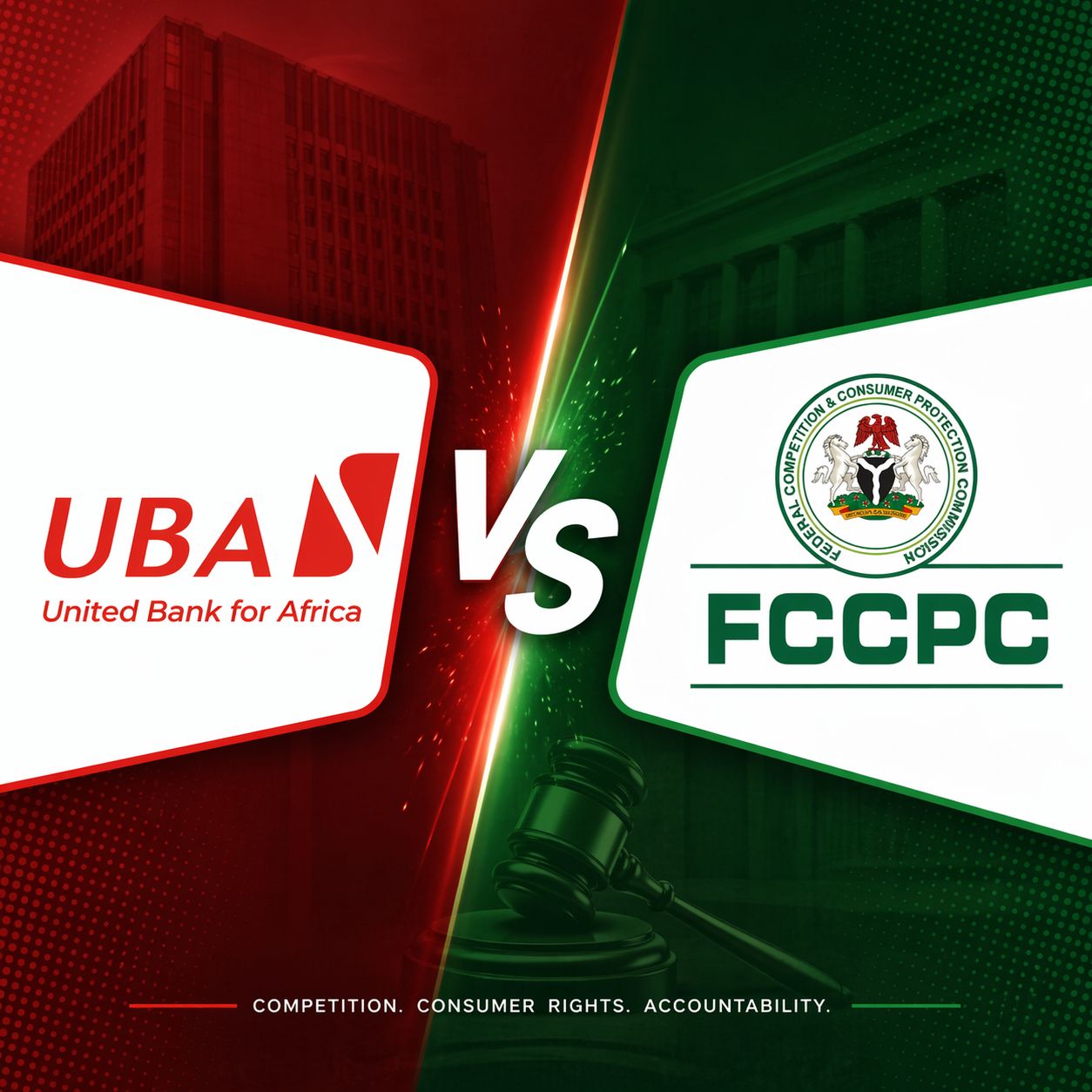
On April 22, 2026, the Federal High Court in Abuja delivered a landmark decision that could reshape consumer protection within Nigeria’s financial system.
In a suit brought by a commercial bank United Bank for Africa (UBA), the court affirmed the authority of the Federal Competition and Consumer Protection Commission (FCCPC) to investigate consumer complaints involving banks and their customers.
What Happened
The case centered on whether the FCCPC could lawfully exercise oversight over banking operations, given the provisions of the Banks and Other Financial Institutions Act 2020 (BOFIA), which governs licensed financial institutions.
The bank argued that BOFIA limits external regulatory interference.
However, the court held otherwise.
The Legal Position
Justice James Omotosho ruled that:
Section 104 of the Federal Competition and Consumer Protection Act 2018 takes precedence in matters relating to consumer protection and competition.
This confirms that:
- The FCCPC can investigate complaints involving banks
- Consumer protection oversight is not exclusive to financial regulators
- Regulatory authority can exist concurrently across sectors
Why This Matters
A Shift in Regulatory Power
This decision settles a long-standing tension between:
- Banking regulation under BOFIA
- Consumer protection under FCCPA
It clarifies that banks are not insulated from broader consumer protection laws.
Stronger Protection for Consumers
With rising complaints around:
- Failed transactions
- Unauthorised deductions
- Hidden charges
- Fraud and digital lending practices
Consumers now have an additional, independent channel for redress beyond their banks and the Central Bank of Nigeria (CBN).
Increased Compliance Pressure on Financial Institutions
Banks and fintech companies must now operate under:
- Financial regulation
- Consumer protection scrutiny
This expands legal risk exposure and demands stronger:
- Transparency
- Customer complaint systems
- Internal compliance frameworks
The Bigger Picture
This ruling reflects a deeper reality:
Modern financial services cut across multiple regulatory domains.
As digital banking, fintech, and data-driven services grow, Nigeria’s legal system is moving toward:
- Shared regulatory responsibility
- Broader consumer protection coverage
This is more than a jurisdictional clarification, it is a policy signal.
Consumer protection is becoming central to financial regulation in Nigeria.
For businesses, this means:
- Legal compliance must be holistic, not siloed
- Customer experience is now a legal issue, not just an operational one
For regulators, the next step is clear:
- Build coordinated enforcement frameworks
- Reduce friction between overlapping mandates
Practical Takeaway
For Financial Institutions & Startups:
- Audit your customer-facing practices
- Align with both financial and consumer protection laws
- Prepare for multi-regulator engagement
For Consumers:
- You are no longer limited to internal bank complaint systems
- The FCCPC provides an external path for redress
In the Federal High Court’s decision marks a turning point in how law interacts with everyday financial experiences in Nigeria.
It reinforces a simple but powerful principle:
No sector is beyond consumer protection.
As law continues to evolve alongside society, decisions like this will define the future of trust, accountability, and innovation in Nigeria’s economy.