
Every year, thousands of different business ideas emerge, with a potential to solve human problems and transform industrial nature and generate economic growth. However, a myriad of these ideas never materializes and when they do, a large number of them are not sustainable. This reveals an important truth. Having a brilliant idea is not the same as building a successful business. And it seems apparent that ideas alone are not enough. The common misconception that innovation sells itself has led to the belief that innovation and execution are one and the same.[1] Without proper structure, planning, execution and legal compliance, it may only remain an idea.
Particularly in Nigeria and Africa, these challenges are even more complex because of the rate of economic instability and limited opportunities these environments allow.[2] Infrastructural issues and regulatory difficulties also impede the ability to build a business sustainably. This article examines the issues that cause great business ideas to fail by analyzing the legal, operational, financial and commercial aspects. It also provides certain recommendations that can help innovators sustain their businesses. They include; prioritizing the legal structure early, protecting intellectual property, maintaining proper documentation and seeking professional advice and mentorship.
1. POOR BUSINESS STRUCTURE
One of the major reasons why businesses fail is the absence of a proper business structure. The excitement of the idea itself may distract many entrepreneurs from the legal and operational foundation required to support long-term growth, causing many businesses to begin operation informally and in an unstable manner, which leads to collapse.
To begin with, starting a business without proper legal registration causes a common problem among startups. While it seems cheaper and easier at early stages, unregistered businesses often struggle to open corporate bank accounts, attract investors, access loans or even enter formal contracts with larger organisations.[3] Moreover, this exposes them to personal liability as there is no separation between the individual and the business.
Administratively, this also affects businesses with multiple founders when there is no clearly defined corporate structure regulating decision making and may affect long-term expansion goals. Verbal understandings and agreements may appear sufficient until profit begins to grow and responsibilities become uneven. Lack of written agreements stating the corporate structure, and ones rights and responsibilities can quickly lead to disputes that destroy the business. Ultimately, strong business ideas need a strong structure legally and administratively to survive. Without this, many businesses may fail before reaching their full potential.
2. FUNDING CHALLENGES AND FINANCIAL MISAPPROPRIATION.
Funding challenges are interconnected issues that greatly hinder business sustainability. Particularly for small and medium enterprises (SMEs), they struggle to secure external capital and internal misuse of funds accelerates business failure.[4] First off, most entrepreneurs start businesses without startup capital making it hard to pay for production or marketing. They may rely on personal savings, support from family members or informal borrowing to fund their business, however this is highly unsustainable . Besides this, there are already a number of challenges most businesses face when trying to acquire funding from investors and banks. Most financial institutions view SMEs as high risk which makes it significantly hard to secure bank loans. Also, entrepreneurs often fail to estimate their funding requirements accurately which can lead to high interests or cashflow crises. Poor documentation of financial decisions and a lack of a clear business model can discourage most investors from funding one’s business.
On the other hand, there is the issue of financial misappropriation, which may include poor budgeting and financial planning. Some founders focus only on making sales without properly planning how money will be spent and managed. Hence, they tend to overspend on office spaces or branding, while ignoring crucial aspects that require more funding. Without a proper financial pan, businesses often run into debt which ultimately leads to their failure. From a commercial perspective, a business may receive large investments and still fail when it lacks the proper systems and strategies to make the most of such investments and build a profitable and sustainable business model. In Nigeria and many African countries, these challenges are worsened by a limited access to venture capital coupled with the high interest rate for borrowing from financial institutions.
3. FOUNDER DISPUTES AND INTERNAL CONFLICTS.
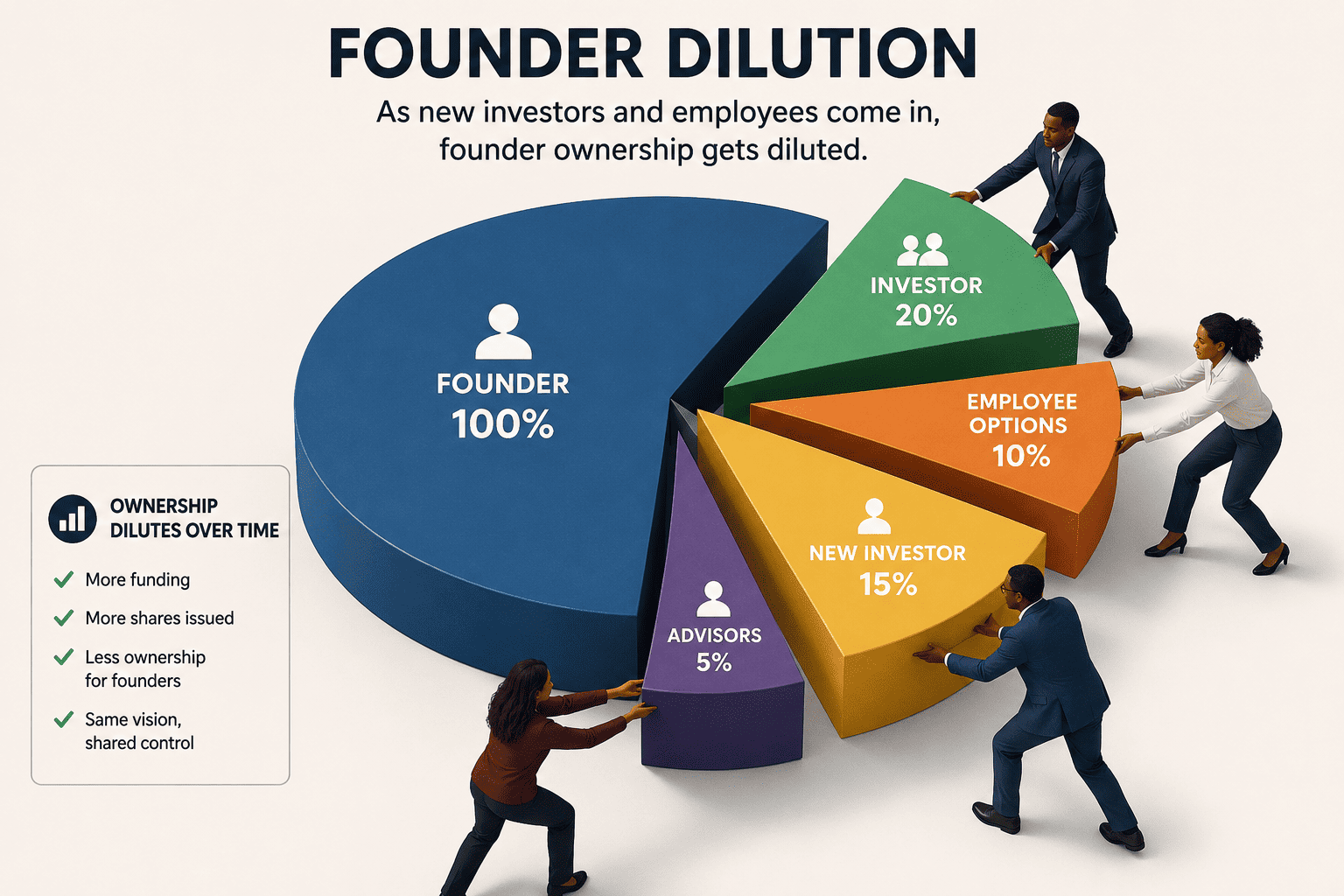
This is one of the most common reasons for business failure. While many startups begin with enthusiasm and shared goals, with growth, disagreements concerning ownership, appropriation of funds and responsibilities often arise.[5] When these issues are not properly attended to, it can likely destroy that business at an early stage, regardless of how innovative the idea seems. From a legal perspective, a failure to create necessary legal agreements early can cause conflicts. Many businesses in Nigeria operate without shareholder agreements, partnership agreements or binding agreements showing decision making powers. Because of this, misunderstandings can easily arise when the business begins to grow and attract investors, with contributors claiming equal control and others claiming exclusive ownership. When unresolved, these issues can lead to litigation or the final dissolution of the business.
Commercially, founder disputes weaken business stability and public image. The credibility of the business is threatened and investors, customers and partners may be reluctant to invest or engage with the business.[6] With regard to administrative activities, internal conflicts can reduce the efficiency within the organisation. Decision making may be slower due to the dispute and miscommunication is made possible. Strategic opportunities may be ignored to take care of disagreements and conflicts. Since many startups in Nigeria begin informally without legal guidance and compliance, the possibility of these disputes is multiplied.
4. LACK OF MARKET VALIDATION
Reports have shown that a whooping 42% of failed businesses in Nigeria occurred as a result of a lack of market validation.[7] This happens when products and services are brought into the market without due consideration for the actual market need for these products. Before launching one’s products, it is impertinent to determine first whether such product is actually needed or if any existing problem is being solved by the product. A large number of entrepreneurs become so engrossed with the idea and assume that the general public will see it in the same light. However, regardless of how innovative a business idea is, it cannot succeed if there is insufficient demand for it in the target market. This issue is largely commercial, as it depends on the genuine need for the product from the public.
From a financial perspective, lack of market validation exposes the business to severe losses as businesses may exhaust available capital on developing products that may never leave shelves and then they would fail to generate enough revenue to keep such business alive. Investors are also less likely to invest in businesses lacking evidence of growth or the potential of growth, as such ventures only pose high financial risks. Moreover, legally, this can also cause issues of consumer protection where products pose possible harm to users, under product liability. Therefore, market research, customer feedback, pilot testing and strategic analysis are very important to develop a business sustainably.
5. POOR NETWORKING AND STRATEGIC RELATIONSHIPS.
This may also contribute significantly to startup failure. Many businesses tend to build up in isolation and without considering the need for strategic partnerships, professional guidance and industrial connections. Hence, founders may make avoidable mistakes or miss crucial opportunities and may struggle with navigating complex challenges. Good networking supports long-term growth which may be hindered by business isolation. Networking also tends to improve access to funding opportunities and investor relationships.[8] This is because financial credibility may also be based on referrals and connections. Consequently, a failure to build strong connections may lead to significant difficulty when securing support for business growth.
6. REGULATORY AND COMPLIANCE ISSUES
This represents a major challenge that affects the sustainability of startups and emerging businesses. A large number of African entrepreneurs underestimate the importance of legal compliance, most especially in the early stages.[9] But this exposes the business to risk of litigation, administrative penalties, reputational damage and financial losses. Non-compliance may occur as a result of lack of awareness by founders or a deliberate avoidance of compliance in order to reduce operational costs.
Commercially, this affects the business’ credibility and its sustainability as well. Investors and other financial institutions may be reluctant to engage with such businesses to avoid losses and possible legal sanctions.[10] This in turn, affects long term growth and stability. Repeated violations may also result in reputational damage or loss of trust from consumers. Moreover, the business administration may also be affected. Governmental sanctions, fines and penalties may significantly affect the business finances and productivity and customer relations or lead to the closure of such business. In essence, regulatory compliance should not be viewed as optional but as a necessity for the sustainability and longevity of any business.
7. LACK OF ACCOUNTABILITY AND POOR GOVERNANCE
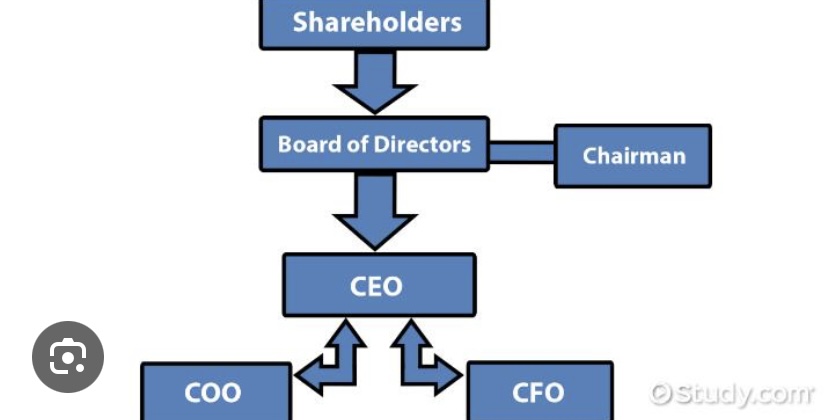
In the early stages of business development, many entrepreneurs prioritize innovation and ideation while neglecting the systems of control and accountability in the business. Essentially, there is a need for proper governance to ensure that financial abuse, poor decision making, internal conflicts and operational inefficiency is avoided. Even small startups require clear structures of leadership, defined rights and responsibilities as well as efficient mechanisms to monitor the performance of the business and finances. A lack of accountability and poor governance leads to financial misappropriation, misuse of resources, unauthorized transactions, and conflicts between employees and founders. From a commercial view, such a business seems unstable, unreliable and untrustworthy. This makes it difficult to attract investment, strategic partnerships or long term opportunities.
8. POOR EXECUTION AND OPERATIONAL FAILURE.
While the importance of innovation and ideas in entrepreneurship cannot be overemphasized, the ability to effectively implement these ideas more often than not determines whether or not such business can survive. An inability to translate vision into consistent and efficient business operations may tank a business idea. Operational failure occurs when a business lacks the proper internal structures and systems to enable it work its way efficiently to growth.[11] Miscommunication, lack of proper supervision, poor customer service and financial misappropriation are all signs of operational failure. As a business expands, these weaknesses only become more evident and will eventually destroy such business. From a legal point of view, operational failure exposes businesses to contractual breaches and regulatory violations, which places a risk of litigation. Employment disputes may also occur where the employer is unable to perform the duties to provide a safe place of work and access to it, safe equipment, competent staff of men and a safe practice of work. Failure to maintain proper operational procedures greatly threatens business continuity.
THE NIGERIAN AND AFRICAN BUSINESS ENVIRONMENT
While the continent has experienced significant growth in innovation, technology, and entrepreneurship, a large number of startups continue to struggle due to economic instability, infrastructural deficiencies, and regulatory uncertainty.[12] Commercially, businesses in Nigeria operate within highly competitive and unpredictable markets. Inflation, fluctuating exchange rates, low consumer purchasing power, and unstable economic conditions affect business sustainability and profitability. Entrepreneurs must therefore demonstrate adaptability and resilience in order to survive.
Operationally, infrastructural limitations such as poor electricity supply, transportation difficulties, and limited technological infrastructure increase operating costs and reduce efficiency. Many startups spend substantial resources addressing problems that businesses in more developed economies may not encounter.[13] From a legal and regulatory perspective, businesses often face bureaucratic delays, multiple taxation, inconsistent government policies, and complex compliance requirements. These challenges may discourage innovation and increase the cost of doing business.
CONCLUSION
It is important to note that while these issues may cause a startup or business idea to crumble, they may not act in isolation. According to Opeyemi Adesina, the purpose for which one starts a business may also determine whether or not it is sustainable. Hence, where one’s intentions are illegal or inconsistent with the nature of the field such business borders on, it may contribute significantly to the failure of such business. Conclusively, Having a brilliant idea is not the same as building a successful business, without proper structure, planning, execution and legal compliance, it may only remain an idea.
REFERENCES
[1] Forbes Coaches Council, ’11 Reasons Why Most Entrepreneurs Fail’ (Forbes, 5 July 2019)
<https://www.forbes.com/councils/forbescoachescouncil/2019/07/05/11-reasons-why-most-entrepreneurs-fail/> Accessed 15 May, 2026
[2] ‘7 reasons Why 90% Of African Startups Fail And How To Avoid Them’ (BusinessDay, 22 March, 2025)
<https://businessday.ng/bd-weekender/article/7-reasons-why-90-of-african-startups-fail-and-how-to-avoid-them/> Accessed 15 May 2026
[3] Lak Ananth, ‘The Six Reasons For Business Failure And How To Address Them’ (Entrepreneur, 6 January 2022)
<https://entrepreneur.com/the-six-reasons-for-business-failure-and-hpow-to-address-them/> accessed 15 May 2026
[4] Mutoko, W.R., 2015 ‘Challenges of financing small, medium and micro enterprises: the case of Botswana manufacturing sector’, Journal Of Business And Management Dynamics 5(1), 7 pages. https://dx.doi.org/10.4102/jmbd.v5i1.17 accessed 12 May 2026
[5] Lak Ananth, ‘The Six Reasons For Business Failure And How To Address Them’ (Entrepreneur, 6 January 2022)
<https://entrepreneur.com/the-six-reasons-for-business-failure-and-hpow-to-address-them/> accessed 15 May 2026
[6] Michael T Deane, ‘Top 6 Reasons New Businesses Fail’ (Investopedia, 25 February 2026) <investopedia.com> accessed 15 May 2026
[7] Marcel Deer, ‘Top 10 Reasons Startups Fail and What to Do About It’ (HubSpot, 28 March 2023) <hubspot.com> accessed 15 May 2026.
[8] Michael T Deane, ‘Top 6 Reasons New Businesses Fail’ (Investopedia, 25 February 2026) <investopedia.com> accessed 15 May 2026
[9] ‘7 reasons Why 90% Of African Startups Fail And How To Avoid Them’ (BusinessDay, 22 March, 2025)
<https://businessday.ng/bd-weekender/article/7-reasons-why-90-of-african-startups-fail-and-how-to-avoid-them/> Accessed 15 May 2026
[10] Mutoko, W.R., 2015 ‘Challenges of financing small, medium and micro enterprises: the case of Botswana manufacturing sector’, Journal Of Business And Management Dynamics 5(1), 7 pages. https://dx.doi.org/10.4102/jmbd.v5i1.17 accessed 12 May 2026
[11] Forbes Coaches Council, ’11 Reasons Why Most Entrepreneurs Fail’ (Forbes, 5 July 2019)
<https://www.forbes.com/councils/forbescoachescouncil/2019/07/05/11-reasons-why-most-entrepreneurs-fail/> Accessed 15 May, 2026
[12] ‘7 reasons Why 90% Of African Startups Fail And How To Avoid Them’ (BusinessDay, 22 March, 2025)
<https://businessday.ng/bd-weekender/article/7-reasons-why-90-of-african-startups-fail-and-how-to-avoid-them/> Accessed 15 May 2026
[13] Marcel Deer, ‘Top 10 Reasons Startups Fail and What to Do About It’ (HubSpot, 28 March 2023) <hubspot.com> accessed 15 May 2026.